
You just gotta laugh at some of the headlines these days. What do you think if you read the above headline? I'd think: "Great! People have finally wised up and realize dietary fat isn't evil!"
But, of course, I'd be quite wrong.
This headline was actually related to new research coming out of Wake Forest University. Researchers have apparently done some knockout-mice research that offers the promise of genetically altering US so we don't suffer from eating that nasty fat.
A "knockout mouse" sounds like a cartoon character, but it's actually a hot thing in genetic research circles. A knockout mouse is one that has had a specific gene or set of genes "knocked out" for research purposes. In this case, the mice had their ACAT2-producing gene removed. The ACAT2 enzyme affects the impact of fat when ingested.
I'm making jabs at this research but it really is quite promising for people with the predisposition to develop atherosclerosis, regardless of whether that atherosclerosis is actually caused by a particular kind of fat.
On the other hand, it could just open the door for people to think they have a "free pass" when it comes to doughnuts or other trans-fatty foods that also contain a lot of sugar and simple carbs. Then folks won't have atherosclerosis but it sure won't have an impact on diabetes, obesity or overall health.
Knockout THOSE mice, why don't they?

Yo dog, check it out. (Sorry--too much American Idol and if you didn't recognize it, that was my Randy Jackson impression.)
There's a new book out within the past few days that I find quite interesting. It's called Rethinking Thin: The New Science of Weight Loss--and the Myths and Realities of Dieting, and is written by New York Times reporter Gina Kolata.
The New York Times ran an excerpt yesterday, and it's quite fascinating.
Basically it talks about some studies with which I was unfamiliar, and a few I'd heard of, studying the genetic link to obesity. I always knew it was strong--take one look at my family and that wouldn't be up for any debate. But it seems to be even stronger than I thought.
Now, I should have this caveat up front: I don't think genetics means losing weight is hopeless. It means losing weight will be harder for some people, and it means maintaining weight loss will be harder still. Study upon study has shown that most people who lose weight gain it back. Here's a big reason why.
Back in 1959, a Rockefeller University researcher named Jules Hirsch conducted a groundbreaking study on obese people. He wondered whether, when obese people lost a lot of weight, their fat cells shrunk or disappeared. He took eight people with lifelong obesity, put them on a 600-calorie liquid diet, had each of them lose on average 100 pounds, and then looked back at their fat cells. He was satisfied--the formerly obese folks' fat cells hadn't disappeared but they had shrunk to a "normal" size.
He sent them all on their merry ways, but then was horrified that they all regained the weight (duh, how many went back home to 600-calorie liquid diets). Anyway, they repeated the study and got the same results every time, but in subsequent studies also monitored diet, activity, psychiatric conditions, and metabolic rate.
Ding ding ding. Every obese person who lost weight measured metabolic rates comparable not with normally thin people but with people who were starving. They also had a psychiatric syndrome called "semi-starvation neurosis" that had been observed in people of normal weight who had been starved. Anxiety, depression, secreting of food, binging.
The excerpt in the Times notes other studies but the bottom line is this: there's an 80% chance that if your parents are obese you will be too. Is it impossible to lose weight? Of course not--there are so many of you out there who've lost lots of weight and have kept it off with a low-carb lifestyle, particularly.
But point is, you who have kept it off have also kept your weight on the front burner. As the book says, "there were a few who did not get fat again, but they made staying thin their life's work."
Which, I suppose, is one of the reasons we write blogs and read blogs and stay focused on weight and health issues. And because of the low carb diet's satiety factor, which is I think its biggest advantage of all, I wonder if that changes the equation any.
So many questions. What do you think?

What a surprise!
"Rating the Diets," touts the new issue of Consumer Reports. "Plans that work best. How good are the latest diet books? Plus 8 simple ways to lose weight (& 3 to avoid)."
Oh boy, I know this is gonna be good.
Let's see. Let's rank the 8 most-tested diet plans, from best to worst:
1. The Volumetrics Eating Plan, by Barbara Rolls. (basically, fill up on bulky calorie-bereft foods to find satiety)
2. Weight Watchers (low fat)
3. Jenny Craig (low fat, eat their food)
4. Slim Fast (low fat, eat their meal substitutes)
5. eDiets. (low fat, unless you use their website to follow any other plan of your choice--for a fee--including low carb)
6. The Zone (equal carbs, fats, protein)
7. The Ornish Diet (ultra low fat)
8--ta da--worst, and the only diet to get a negative rating:
Dr. Atkins New Diet Revolution
Here is what the brainwashed drones expert panel says about Atkins: "There’s growing evidence that dieters aren’t as hungry on Atkins as on some other diets. But many find it too restrictive, so long-term adherence is below average; long-term weight loss is average. Its nutritional profile is far outside dietary guidelines." In their ratings chart, Atkins received a below-average overall rating, with a "worst" rating for nutritional content.
And what are the 8 strategies that work, and 3 that don't?
1. Eat breakfast. (okay here)
2. Choose (and limit) your fats. (sigh)
3. Eat sparingly. (and strive for anorexia!)
4. Exercise (yeah, yeah, whatever)
5. Consider cutting carbs. (Who. Wha-huh? They just ripped Atkins. Methinks they speak with forked tongue--with some sauce on the side. But I digress...)
6. Fill up on low-density foods. (Yeah,pile on that rice and be hungry again in 30 minutes)
7. Weigh often (I've tried three times a day and it's frustrating)
8. Eat a monotonous diet--too much variety stimulates your appetite. (oh.kay.)
The three "not-so-workable" strategies:
1. Diet drugs. (I'm with them here.)
2. "Angel" and "Devil" foods--seeing any food as evil sugar rat poison or perfect.
3. The glycemic index. Why? Because it tempts you to make foods "evil" and you don't know how to count mixed foods.
ARRRGGGHHH (sound of hair being ripped from scalp). Now, that won't confuse folks, will it? Talk about "Junkfood Science."

Feast and Famine and Sugar, oh my!
A couple of interesting pieces from the London Daily Mail that there are symptoms of famine in the UK.
Apparently, the number of hospital patients diagnosed with malnutrition has risen by 44 percent in the past five years--4,000 cases last year alone. Experts estimate that the real number is more like 3.6 million.
In the worst cases, the symptoms of malnutrition are pot bellies, wasted limbs and emaciated bodies. But the millions not at that point are more likely to be obese, lethargic and suffering vitamin and mineral deficiencies.
The cause, experts say, is a growing reliance on fast food coupled with binge drinking.
It's really a pretty scary article.
Now, think of it in terms of this piece about how the amount of sugar in so-called "healthy products" has doubled in the past 30 years. Picked out as the worst offenders? Breakfast cereals, so-called "whole-grain" breads, and soups. Special K cereal--touters of big "eat us twice and day and take off the weight" campaigns--went from 9.6 grams of sugar in 1978 to, currently, 17 grams of sugar. And that's not to mention their "Vanilla Almond" and other flavors with extra sugar. The article points out that while the UK government and watchdog groups have focused on the amount of salt in foods and on the table, the spiraling use of sugar has gone unchecked.
And so have the rates of diabetes and obesity and insulin resistance and all other sorts of good things.
Warning--this is just me whining and has no relation to diet. Just in the interest of full disclosure so you don't get to the end of this and say, "What does that have to do with weight loss or health?"
Remember the old disaster movie spoof "Airplane?" Leslie Nielsen's character, puffing on a dozen cigarettes at once, says something like "Looks like I picked the wrong day to quit smoking."
Well, looks like I picked the wrong day to start training for a marathon--or to walk, for that matter. See, I have a couple of boo-boos.
It all started at Home Depot, as so many of my personal disaster stories have since Hurricane Katrina. Last week, a plumber told me my bathroom sink leak couldn't be repaired--I needed to replace the 1930s-era faucet set in my 1900-era house, but I probably couldn't find anything to fit so I'd need a new sink too, and then once the 1930s pedestal sink came out I'd need to refloor the bathroom because the tile wouldn't fit around a different-sized base.
Okay.
I search the Internet for the rare faucet set with a 12-inch spread, highly resenting that I am not independently wealthy, surrounded by servants and know things like what a widespread faucet set is. And I find a few 12" ones from restoration sites but they're outrageously expensive.
So I go sink shopping. I find a nice beadboard white small vanity that will fit in the tiny bathroom and has a larger base so I don't have to refloor the room. A nice marble vanity top and sink. An old-fashioned looking brushed nickel faucet set. And home I go.
Superwoman! I decide to unload the car, having no handy-dandy males standing around flexing their muscles and offering to help.
I manage the 75-pound vanity up the brick stairs with much huffing, puffing and rest-stops along the way.
I pick up the marble vanity top and sink. Hm. About 40 pounds, I'd guess. Piece of cake. I wobble up the steps, into my entry hall and...
WTH?
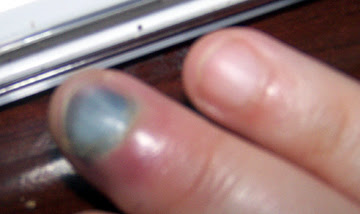
I'm lying face down on the floor with my face in the marble sink, my shoes have flown off in multiple directions, my body is twisted in some strange formation. The sink isn't broken--its impact was absorbed, for better or worse, by the middle finger of my right hand. After the immediate shock passed and I managed to get myself upright, I realized the nail of my finger had already, in less than a minute, turned a lovely shade of turquoise that just happened, coincidentally, to match my shirt.
As the day and night passed, new maladies arose. A badly bruised and hyperextended foot. Big-ass bruise on leg and arm, back spasms. Oh and did I mention my finger HURTS LIKE HELL? It's now black and so swollen I'm expecting it to shortly split like a hot dog in the microwave.
Oh well, at least the sink didn't break.

Well, I tried. I tried to be a good citizen in my weekly shopping today. But the barriers were too overwhelming.
Barrier #1 is 81 years old and goes by the name of Mom. She wants Yoplait fruity yogurt. She wants Special K Vanilla Almond. She wants Blue Bell Cherry-Vanilla ice cream. I cannot buy those things at Whole Foods or the farmer's market. So off I go to Sprawl-Mart for $125 in Senior & Stubborn Foods. But I refuse to buy Sprawl-Mart produce--here, at least, it's really abysmal, nasty looking stuff.
So next I go to Whole Foods and run into Barrier #2. The only locally produced product in the entire store was strawberries. Now, theoretically, I could live on strawberries and splenda and Kefir. But instead I bought grapes from Chile, onions from California and managed to get the rest of my produce from Texas, which is at least not a half a world away.
So I need to make a big farmer's market run on Tuesday, which is the day the Green Market sets up in the parking lot of the building I work in. Maybe I can eat something local that isn't red with little black seeds.

If you have ever struggled with a weight problem, have you ever felt as if you had to be 10 times better than everyone else just to prove that you're "worthy?" To prove you're good enough to "compensate" for your size?
It's the Shelley Winters syndrome. In one of my all-time favorite disaster pics, Shelley Winters plays the fat lady stuck in the Poseidon Adventure (1972 version) after the ship hits the iceberg, turns upside down and six or seven of our fair heroes follow fallen priest Gene Hackman to their eventual rescue. The survivors are all "types." You have the fallen priest, the waifish girl, the gritty ex-cop with the reformed-hooker wife, the old man, the child, and the fat woman--which is where our fair Shelley comes in.
As they climb and climb to escape the rapidly water-filling ship, they make constant allowances for Shelley so she can get through the tight openings and manage to climb through the physical challenges. Shelley feels bad and is always saying how they're having to risk themselves for the fat lady. Then, finally, they come to a quandary--someone is going to have to swim underwater through a long flooded corridor carrying a rope so the rest can pull themselves through. Wait! says Shelley. I can do it! I once was a champion swimmer! Never mind she hasn't tread water in 40 years and 60 pounds.
But she does it, by gosh. She jumps in, swims and swims, secures the line, and then, of course, promptly dies of a heart attack. She has sacrificed her life to prove she was worth saving.
The reason I even began thinking about it was from reading this BBC piece about ethical dilemma questions. Two of the four questions involve sacrificing fat people to save other, presumably thin, people. I found the questions mildly offensive, but it did really make me start thinking about how often we sacrifice ourselves out of some misguided attempt to make people like us/think we're "good people"/think we're worthy of something.
How hard and how often do you try to "prove yourself?"

So, after our discussions yesterday--and thanks, Tess, for the yogurt tips!--here is the Four Corners Diet recipe for making your own yogurt or kefir with nothing more complicated than a glass jar. The yield is 4 servings; serving size is 1 cup.
Ingredients:
1 quart whole milk
1 ounce starter culture
1. Purchase your first live-culture kefir or yogurt from the grocery store. Make sure it is plain, with no fruit or sugar added, and make sure it says "contains live cultures" (not "made with live cultures"). Take out about 2 tablespoons to use as your starter.
2. Place a bottle of milk in a large pot containing enough water to cover half the bottle. If you buy your milk in a carton or plastic jug, transfer it to a clean glass bottle.
3. Open the lid a little to allow for expansion of the liquid. Bring water to a boil and simmer for five minutes. You have now pasteurized your milk. Allow milk to cool to room temperature.
4. Add 2 Tbsp of kefir or yogurt to each quart of cooled milk and put the bottle top on. Mix the starter with the milk. Place bottle on top of fridge and leave for at least 24 hours. In cool climates you may need 36-48 hours.
5. You have yogurt or kefir! Save out 2 Tbsp for your next batch.
Just FYI--you can also make it with skim milk or 2% but it will be thinner. Two-thirds of the milk sugars/lactose will be removed by the culturing process. Homemade yogurt will keep up to two weeks in the refrigerator.
Nutritional info per 8 ounce serving, made w/ whole milk:
135 calories
4 grams effective carbs (11 g total)
8.1 grams fat
5 g saturated fat
2.3 g monounsaturated fat
.3 g polyunsaturated fat
33 mg cholesterol
8g protein
291 mg calcium
33 mg magnesium
120 mg sodium
370 mg potassium
.1 mg iron
228 mg phosphorus
2.3 mg vitamin c

So despite my rant a couple of days ago about being bored with my diet, I have to agree with Livin' La Vida Low Carb buddy Jimmy Moore's questioning of the intestinal fortitude of anyone who gets bored eating low carb. Sound like a contradiction? Not really.
I have a character flaw, you see. My name is Suzique and I am a tad obsessive. Well, okay, more than a tad. Suzique needs something to obsess over, diet-wise, and once her eating plan becomes too automatic and easy, she need to shake things up a bit.
Which is why she did some low-carb reading and decided to have a crack at the Four Corners Diet, which is the re-named, updated GO-Diet devised in the late '90s by Drs Jack Goldberg and Karen O'Mara.
If there was ever a diet designed to cater to a middle-aged obsessive, uh, woman of stature, shall we say, this is it. I can count and count and count to my heart's content. I can devise myriad Fitday charts and goals to track. I'm as happy as a melamine-fed pig at a quarantined hog farm (can you tell I'm still really PO'd about this latest federal bunglefest?).
Anyway, the four corners of the table on which this food-happy eating plan stands are:
Corner #1) Low carbs. Limit net carbs to 50 or fewer a day. 50 grams of carbs?? That sounds like a TON. Can I lose weight on 50g a day? Can my 50g of carbs come from Blue Bell ice cream? Well, no. Because part of this #1 Corner is a tad more specific and bans the usual suspects (thankfully): sugar, starches, etc. And a max of 15 net carbs per meal.
Corner #2) High monounsaturated fat. Drs. GO tiptoe cautiously around the issue of saturated fat and don't find themselves willing to go all-out and give sat-fat their blessing. So the program asks not that you limit fat intake at all--the more, the merrier--but that 50% of your fat intake come from monounsaturated fats. Between my great fondness for Cardini Original Caesar salad dressing and anything drenched in olive oil, this will not be a problem.
Corner #3) High fiber, to the tune of a minimum 25-30 grams a day. And I may mean "tune," literally, y'know? Do any of you add flax to your foods? I figure I will snack on a couple of yummy Chocoperfection Chocolate Bars a day, at 14g of fiber each and 2 net carbs, and that requirement will be taken care of, at least until I'm hauled away in the paddywagon to the poor house because I've spent my mortgage payments on the not-so-cheap Chocoperfection Bars (although the best prices I've found on them are at Netrition, fyi).
Corner #4) Pharmafoods. Now, this is an interesting corner to me given my interest in functional foods, though there are still lots of questions about the validity of their claims. The Four Corners plan calls for some form ofprobiotics every day, plus five servings of vegetables per day, as many as possible from the "pharmafoods" group, which they say are foods whose nutritional punch is greater than the sum of their micronutrients: dark green vegetables, nuts and seeds, high-fiber low-sugar fruits such as berries and melon, broccoli, onions, peppers, etc.
Now, if you've stuck with me this far, you'll finally get to the thing I really want to talk about, which is yogurt, namely full fat yogurt without sugar added. Apparently there is a consensus among low carb "experts," thatyogurt carbs aren't "real" carbs as long as the yogurt contains live cultures. (This supposedly also is true of buttermilk but since I don't know what to do with buttermilk other than make cornbread, I don't care.)
Note I said "CONTAINS" live cultures and not "MADE WITH" live cultures. If your yogurt says it's made with live cultures, chances are they aren't live any more. So look for the word "contains." Said cultures feed on the lactose in yogurt, rendering it a non-carb. What's left, the whey, can be strained off the top.
Or you can enjoy kefir, which I have trouble finding, or something like Fage Total, which is a strained Greek yogurt that has 7g of carbs per 8-ounce serving. I added a little Torani Sugar-Free Irish Cream syrup to it this morning and it was quite the treat.
So, low-carbers, what's your take on yogurt?

I collect novelty cookbooks. As I scan over my shelves, I find such delights as The Nancy Drew Cookbook, Gilligan's Island Cookbook, Are You Hungry Tonight--Elvis' Favorite Recipes, and one of my favorites, the Mike Douglas Cookbook: Recipes Made Famous on the Mike Douglas Television Show.
OK, I'm showing my age here. I actually REMEMBER the Mike Douglas Show.
Anyway, it was with delight from a collector's viewpoint -- and horror from a dietary viewpoint -- that I heard the news that white, squishy Wonder Bread has released, in honor of its 85th birthday, the Wonder Bread Cookbook. You can buy it at Amazon for a discount if you also purchase The Twinkies Cookbook.
The Wonder Bread books touts itself as "an inventive and unexpected recipe collection," which just begs one to ask: so, what's in it? Well, there are:
• Good Morning Wonder Bread, with breakfast recipes such as Pigs in Wonder Blankets.
• Wonder Bites, with appetizers such as Wonder Beef Cups
• Wonder Sandwiches, such as Grilled Baloney (sic) and Wonder
• Baked Wonder, including Sweetened Tomato and Wonder Casserole
• Sweet and Fruity Wonder, including the Wonder Easter Egg Sandwich
• Wonder Bread Pudding and Crepes, including Wonder Caramel Apple Bread Pudding
• It's a Wonder, an unidentifiable category with such delights as Creamed Fish in Wonder Patty Shells and Pilgrim Pies.
It is a wonder.
I'll leave you instead with a selection from the Mike Douglas Cookbook:
Lady Bird Johnson's Spinach Souffle
2 packages frozen, chopped spinach
1/4 cup butter
1/4 cup flour
Milk or cream as needed (approx 1-1/2 cup)
1 cup grated Cheddar cheese
Dash nutmeg
1 tsp salt
1/8 tsp pepper
1 Tbsp sugar (Splenda hadn't been invented yet)
1 tsp grated onion
5 eggs, separated
Preheat oven to 375. Thaw spinach. Drain. Reserve liquid. Add enough milk to liquid to make 2 cups.
Melt butter over low heat. Add flour and blend well. Cook 10 minutes, stirring occasionally. Add milk gradually, stirring constantly. Cook until thick. Add spinach and remaining ingredients except eggs. Cook for or five minutes over low heat, stirring to prevent scorching. Remove from heat. Beat egg yolks until thick. Add equal amount of spinach mixture and blend well. Add to first spinach mixture.
Beat egg whites until stiff but not dry. Fold spinach mixture into egg whites. Pour into greased 2-quart casserole. Set in pan containing 1 inch of hot water and bake 40-50 minutes or until table knife inserted 2 inches from the edge comes out clean.
Serves 6.


